
AKDB · Engineering preview
A connected foundation, not a single tool.
AKDB connects architecture decisions, requirements, relationships and source history within a project. It helps establish which information is relevant, current and authoritative. ContextOps is a separate system for coordinating bounded work: who may act, within which scope and how results return for review. Neither a generated answer nor a completed tool operation grants itself approval.
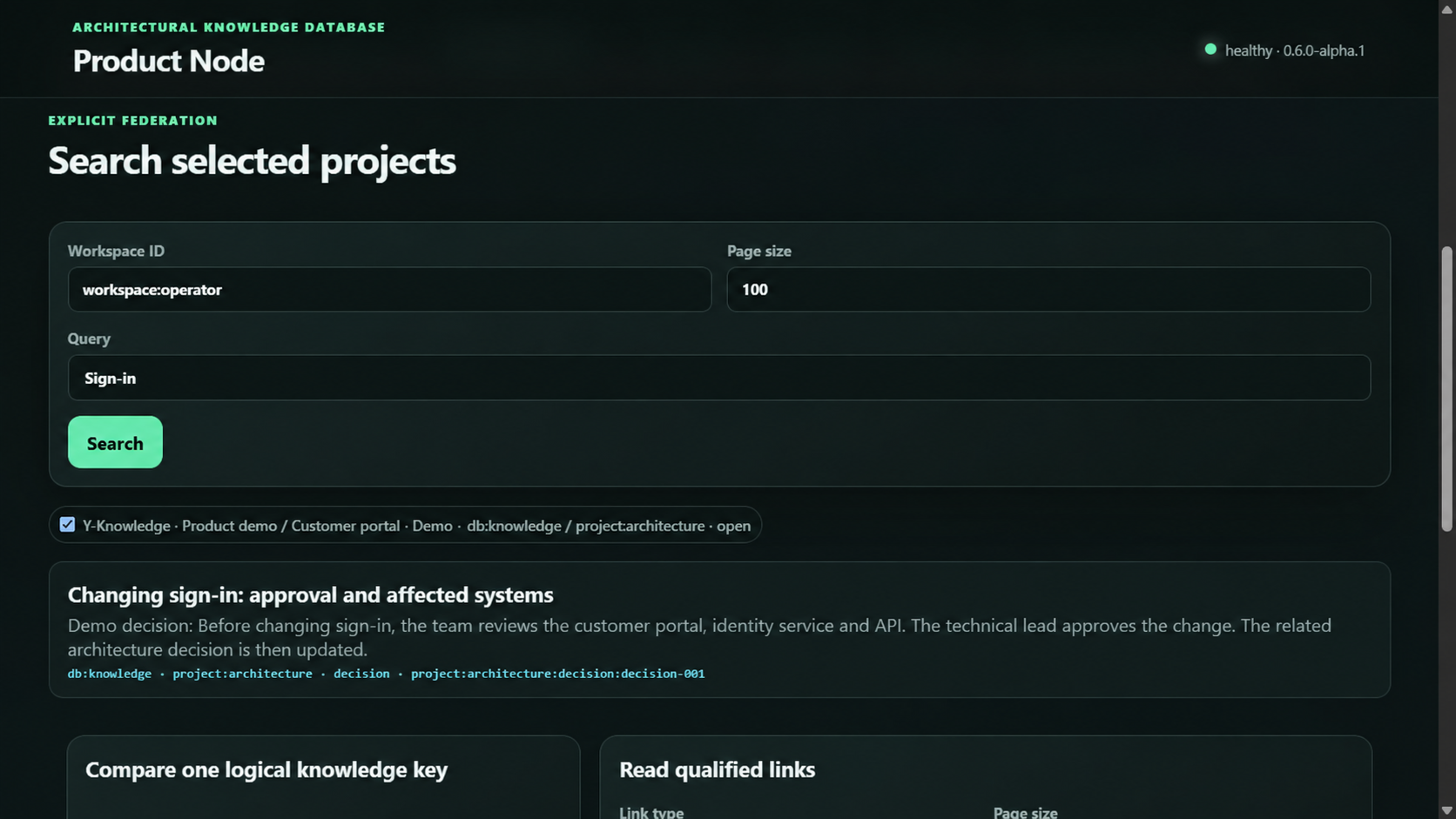
The image is an English-localized illustration based on the historical Product Host 0.6.0-alpha.1 search screenshot and fictional data. Its labels and example text have been translated. It does not document an English-language deployment, later inspection features or customer results.
AKDB · Engineering preview
A research-grounded direction. An inspectable foundation.
The AKDB scientific engineering report describes the direction: connect knowledge, versioned rules, execution authority and reviewable evidence in one engineering loop. Its implementation assessment covers project-scoped knowledge, architecture authoring, context packs, retrieval, revision history and coordination—not just search or a device application.
The report’s historical SQLite and PostgreSQL checks support selected internal invariants at their recorded versions. Its September 2026 revision-10 draft separates those results from newer implementation observations. It is an internal scientific engineering assessment, not an independent effectiveness study. Better retrieval, fewer review corrections and reproducible outcomes are defined as questions to test—not benefits already proven.
AKDB · Engineering preview
What we would evaluate with your team.
Agree one task, permitted sources and the questions to answer. Check source coverage, correctness and reviewer effort. Where data must stay inside a closed environment, also evaluate which functions work locally and what installation, updates and recovery require. Include ongoing maintenance in the cost comparison, and agree when to stop if the case is unsuitable.
There is no production write access in this proposed evaluation. Data location, model access, retention, responsibilities and timing must be agreed before using real information. A standard delivery duration is not promised.
See how this relates to a software changeBehavior comparison: implementation and evidence.
Source review on 6 September 2026 includes comparison of reviewed intended and inspected behavior, with conditions and computed values retained. Outcomes distinguish differences from unknowns when the investigation is incomplete. This is bounded analysis, not proof of universal program equivalence.
AKDB 0.5.0 is the tagged baseline; the newer work belongs to active 0.6 development. Internal server checks and synthetic component tests support their recorded scope, not acceptance of a complete Y-Knowledge service. A working package still has to be qualified for the intended evaluation.
Delivery checks and decision registration.
The Product Host presents human-readable outcomes and operation receipts. Acceptance checks bind design judgments and implementation judgments to the exact inputs assessed, the delivered source and its verification evidence. A result from another version is not automatically evidence for the current delivery.
Existing decision documents can also be previewed and registered by an authorised human owner, with content and revision checks. Conflicts refuse silent replacement. Registration records the action; it does not grant design approval.
The new Xbox track: a complementary implementation path.
The Xbox track covers only a subset of the solution: the native local workspace. Its local databases, knowledge updates, retrieval and recovery, visible local owner setup and bounded offline embedding component have scoped desktop evidence. These records do not qualify the AKDB server or the complete product.
The 10 September 2026 development record adds local operation progress beyond the report’s earlier native cutoff. It also records a failed catalog comparison: four of 36 command outcome codes matched the server reference, while 32 differed. That comparison was not a physical-device qualification and does not establish full behavioral equivalence. Earlier device startup observations remain separate. Physical-device qualification, server equivalence and suitability for a sensitive environment remain open.
Current limits of the offer.
Complete impact analysis, autonomous gap repair and active third-party integrations are not promised capabilities. Adapter packages and remediation plans remain development work; they do not mean your external accounts are connected.
Native-device work is a separate qualification track. Local processing alone does not establish secure isolation, approved use with sensitive data or lower operating cost. Independent customer outcomes and repeatable delivery remain to be established.
Inspect the source. Check the result. Decide whether it helps the work.